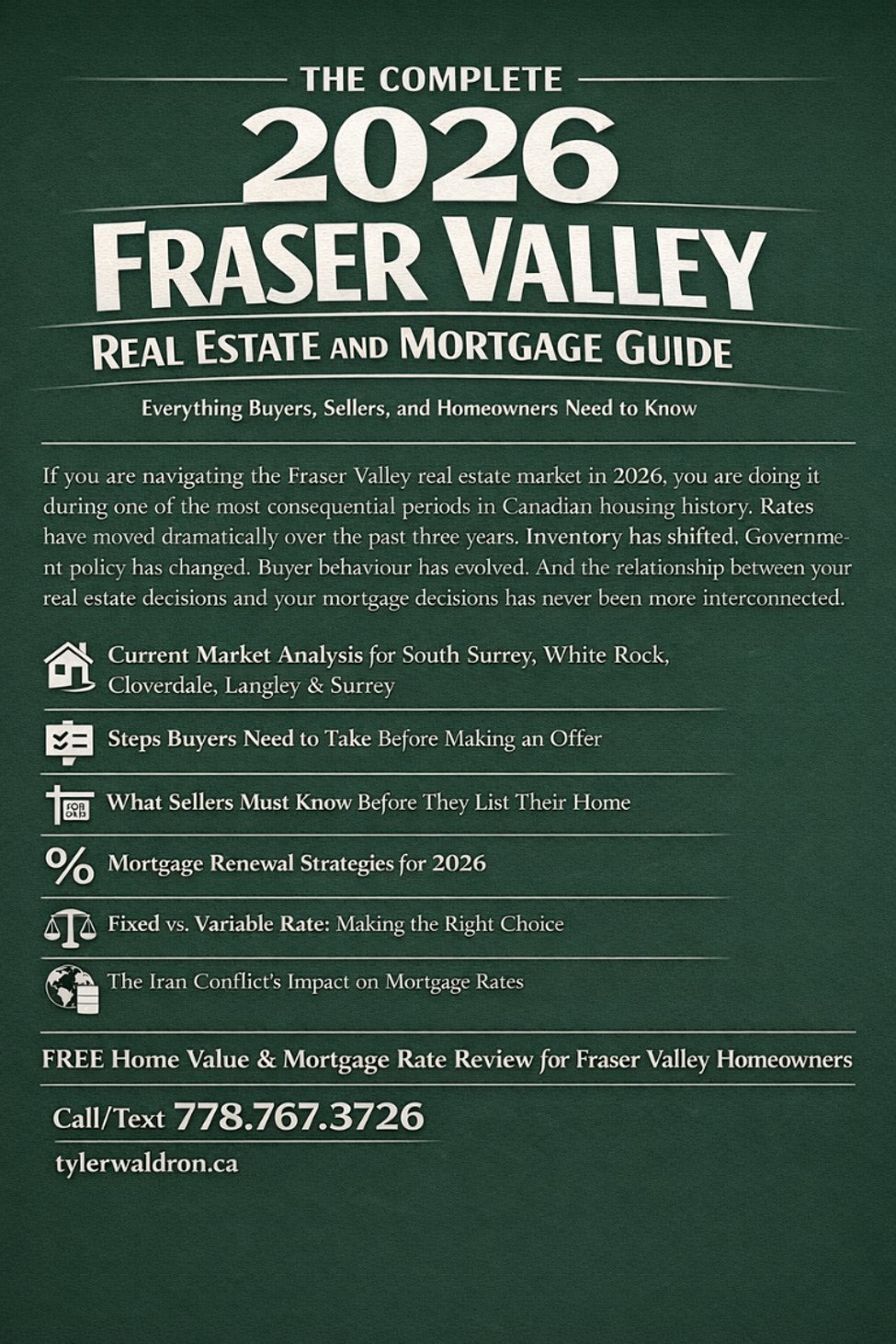
If you are navigating the Fraser Valley real estate market in 2026, you are doing it during one of the most consequential periods in Canadian housing history. Rates have moved dramatically over the past three years. Inventory has shifted. Government policy has changed. Buyer behaviour has evolved. And the relationship between your real estate decisions and your mortgage decisions has never been more interconnected.
This guide covers everything. The current market conditions across South Surrey, White Rock, Cloverdale, Langley, and Surrey. What buyers need to do before they make an offer. What sellers need to understand before they list. What every homeowner with a renewal coming up needs to know right now. And why the structure of your mortgage matters as much as the rate.
The Fraser Valley Real Estate Market in 2026: What Is Actually Happening
The Fraser Valley Real Estate Board tracks monthly sales and listing data across the region and the numbers tell an interesting story heading into spring 2026. After a period of buyer hesitation driven by elevated borrowing costs through 2023 and 2024, the market is showing renewed momentum. According to the Fraser Valley Real Estate Board's monthly statistics, sales activity in early 2026 is tracking above the same period in 2025 across most property categories.
What is driving the shift is a combination of factors. The Bank of Canada executed a series of rate cuts through 2024 and into 2025, bringing the policy rate down meaningfully from its peak. According to the Bank of Canada's most recent rate announcement, borrowing costs have moderated enough to bring a significant number of sidelined buyers back into active searching.
The result across the Fraser Valley is a market that rewards preparation. Buyers who are pre-approved and ready to move are finding opportunities. Buyers who are still figuring out their financing are watching those opportunities close in front of them.
South Surrey and White Rock: The Most In-Demand Communities in the Fraser Valley
South Surrey and White Rock consistently attract the highest demand of any submarket in the Fraser Valley and the reasons are structural, not cyclical. Proximity to the US border. Access to the White Rock waterfront and promenade. Some of the highest performing schools in British Columbia according to the Fraser Institute's annual school rankings. And a quality of life that is genuinely difficult to replicate anywhere else in the Lower Mainland at comparable price points.
Within South Surrey, each neighbourhood tells a different story.
Grandview Heights has emerged as the most active area for first time buyers and young families in the entire South Surrey market. Newer construction, walkable amenities along the 32nd Avenue corridor, and a price point that still represents relative value compared to more established pockets of the community. Detached homes, townhomes, and condos are all available here at a range of entry points.
Morgan Creek and Elgin Chantrell attract move-up buyers and established families. Larger lots, mature landscaping, quieter streets, and a neighbourhood character that takes decades to build. These are communities where people stay, which tells you something about the quality of life they offer.
Ocean Park and Crescent Beach occupy a category of their own. Oceanside living within 45 minutes of downtown Vancouver. Limited inventory, consistent demand, and a lifestyle that buyers from across the Lower Mainland compete for. When well-priced properties come to market here they move quickly.
Sunnyside Park and Semiahmoo offer some of the strongest value in South Surrey for buyers wanting access to both the 24th Avenue amenity corridor and the border crossing, particularly relevant for buyers with cross-border employment or family ties.
White Rock itself is a distinct municipality with its own character and its own buyer profile. The beach village, Johnston Road dining scene, and the promenade draw both downsizers from larger homes across the Valley and buyers relocating from other provinces and countries who want coastal living without the price tag of West Vancouver or the Sunshine Coast. Condo inventory in White Rock has been particularly active as the downsizer demographic continues to grow.
Cloverdale: The Fraser Valley's Best Value for Families
Cloverdale deserves its own conversation because it is consistently underestimated by buyers who have not spent time there. The Historic Cloverdale town centre gives the community an identity and character that newer masterplanned communities cannot manufacture. The schools are strong. The community events calendar is genuinely impressive. And the price per square foot on detached homes remains among the most competitive in the entire Fraser Valley for buyers wanting newer construction with space.
Clayton Heights and the broader Cloverdale area have attracted significant development over the past decade and the infrastructure has followed, with transit improvements, school additions, and commercial development continuing to expand the neighbourhood's amenities. For families being priced out of South Surrey's detached market, Cloverdale represents a genuine alternative, not a compromise.
Langley: Where the Fraser Valley Buyer Finds Space
Langley continues to absorb significant demand from buyers who want detached living, more land, and a slower pace without completely sacrificing proximity to Metro Vancouver. The Township of Langley has one of the most active development pipelines in BC, with new communities, transit expansion planning, and commercial growth that continues to attract both buyers and investors.
Willoughby Heights in particular has been one of the fastest-growing communities in BC over the past five years. The density and pace of development here means buyers need to understand strata fees, depreciation reports, and the difference between newer and more established sections of the neighbourhood. These are nuances that matter when you are making a purchase of this size.
Fort Langley remains one of the most charming communities in the entire Lower Mainland. Heritage character, the historic downtown, the Fraser River backdrop. Inventory is consistently limited and demand is consistently high. If Fort Langley is your target, preparation and speed are essential.
What Every Fraser Valley Buyer Needs to Do Before Making an Offer
The single most important thing a buyer can do in the 2026 Fraser Valley market is get properly pre-approved before they start searching. Not pre-qualified, which is an informal estimate based on information you provide verbally. Pre-approved, which involves a full review of your income, credit, and assets by a lender who is prepared to commit to financing.
The Canada Mortgage and Housing Corporation outlines the full home buying process including what documentation is required for a proper pre-approval. The key items are your most recent Notice of Assessment from the CRA, two years of T4s or T1 Generals if you are self-employed, recent pay stubs, three to six months of bank statements, and confirmation of your down payment source.
Pre-approval does two critical things. It tells you exactly what you can afford so you are not wasting time looking at properties outside your range. And it locks in your interest rate for 90 to 120 days, which means if rates move upward while you are searching, you are protected at the rate you were approved at.
Down payment rules in Canada are set federally and administered through CMHC. For properties under $500,000 the minimum down payment is 5%. For properties between $500,000 and $999,999 it is 5% on the first $500,000 and 10% on the remainder. For properties over $1,000,000 the minimum is 20% and mortgage insurance is not available. The Government of Canada's down payment rules page has the current thresholds and calculations.
First time buyers in Canada also have access to several programs worth understanding. The First Home Savings Account allows eligible buyers to contribute up to $8,000 per year to a maximum of $40,000 in tax-free savings designated for a home purchase. The Home Buyers Plan allows first time buyers to withdraw up to $35,000 from their RRSP toward a home purchase. Details on both programs are available through the Government of Canada's first-time home buyer incentives page.
The Stress Test: What It Is and Why It Matters
Every mortgage applicant in Canada, regardless of their down payment size, must qualify under the federal mortgage stress test. The stress test requires buyers to prove they can afford their mortgage payments at the higher of either their contracted rate plus 2% or 5.25%, whichever is greater.
This rule was introduced by the Office of the Superintendent of Financial Institutions to ensure borrowers have a buffer against potential rate increases. The OSFI mortgage qualifying rate guidelines outline the current requirements in full.
In practical terms the stress test reduces your maximum purchase price by roughly 20% compared to what you would qualify for without it. Understanding this number before you start searching is essential. There is no point falling in love with a $900,000 home if the stress test means you qualify for $750,000.
Fixed Rate vs Variable Rate: The Decision That Outlasts Your Purchase
The choice between a fixed rate and a variable rate mortgage is one of the most consequential financial decisions a buyer makes and it is one that most people spend far less time on than they spend choosing countertop finishes.
Fixed rates are tied to Government of Canada bond yields, particularly the 5 year bond. When bond yields rise, lenders increase their fixed rate pricing. When yields fall, fixed rates follow. The Bank of Canada's interest rate and monetary policy page explains the relationship between monetary policy decisions and the borrowing costs that flow through to consumers.
Variable rates move with the Bank of Canada's overnight policy rate. When the Bank cuts, variable rate holders see their payments decrease. When the Bank raises, payments increase. Historically, research from mortgage industry analysts has shown that variable rate borrowers have paid less interest over time than fixed rate borrowers in most rate cycles. However past performance is not a guarantee, particularly in volatile rate environments like the one currently being influenced by geopolitical factors including the Iran conflict and its impact on global oil prices and inflation expectations.
The piece that most buyers and sellers overlook entirely is the prepayment penalty. Breaking a fixed rate mortgage before the term expires triggers an Interest Rate Differential penalty calculated by the lender. Depending on your remaining term and the rate differential between your contracted rate and current rates, this penalty can range from several thousand dollars to more than $30,000 on a typical Fraser Valley property.
Variable rate mortgages carry a much more forgiving exit provision, typically three months of interest on the outstanding balance. For buyers who have any possibility of selling within their mortgage term, this distinction matters enormously and should be part of the mortgage structure conversation before you sign.
The BC Financial Services Authority regulates mortgage brokers in British Columbia and provides consumer resources for understanding your mortgage rights and obligations.
Mortgage Renewals: The Most Expensive Conversation Most Homeowners Never Have
Approximately 1.2 million Canadian mortgages were set to renew in 2025 according to CMHC data, and a significant portion of those were originally written at rates below 2% during the pandemic low. Homeowners renewing from those rates into the current environment are facing materially higher payments.
The Bank of Canada's financial stability report has flagged mortgage renewals as one of the key vulnerabilities in the Canadian household balance sheet, noting that the payment shock for renewing borrowers at current rates represents a genuine stress to household finances.
What most homeowners do not know is that the renewal letter their lender sends them is an opening position, not a final offer. Lenders send renewal offers knowing that a significant percentage of borrowers will simply sign and return them without shopping the market. Those who do shop typically find better rates, better terms, or both.
The renewal process should begin four to six months before your maturity date. That window gives you time to properly review your options, compare lenders, and make a switch if the numbers support it. Switching lenders at renewal does not require you to requalify under the stress test in most cases, which removes one of the most common barriers people believe exists to shopping their renewal.
The Case for One Advisor Across Both Real Estate and Mortgages
The traditional model of buying or selling a home involves at least two separate professional relationships. A realtor who handles the property side and a mortgage broker or bank representative who handles the financing. In most transactions these two professionals have never met and are rarely in communication with each other about the specific client they share.
This creates gaps. The realtor does not know what mortgage product the buyer is in and whether it has a large prepayment penalty that will affect the seller's net proceeds. The mortgage broker does not know what the buyer's real estate timeline looks like and whether the mortgage term they are recommending aligns with how long the client plans to stay in the property. Nobody is looking at the full picture.
When a buyer works with an advisor who holds both a real estate licence and a mortgage broker licence, those gaps close. The purchase price, the mortgage structure, the timeline, and the exit strategy are all considered in a single conversation. For sellers who are also buying, the sequencing of the two transactions, completion dates, bridge financing requirements, and the interaction between the existing mortgage and the new one can all be managed by one person with visibility into both files.
In British Columbia, mortgage broker licencing is regulated by the BC Financial Services Authority. All licensed mortgage brokers operating in the province can be verified through the BCFSA's public registry.
What the Iran Conflict Means for Fraser Valley Homeowners Right Now
Geopolitical events rarely feel connected to household finances until they are. The outbreak of conflict involving Iran in late February 2026 provides a clear and current example of how international events transmit directly to Canadian mortgage rates through a chain of economic relationships.
Oil prices rose nearly 50% in the ten days following the conflict's escalation, moving from approximately $67 per barrel to over $100. Energy is an input cost in virtually every sector of the economy. When fuel costs rise, production costs rise, transportation costs rise, and consumer prices rise. That is inflation.
The Bank of Canada's mandate, as defined in its governing legislation and inflation targeting agreement with the federal government, is to keep inflation within a target range of 1% to 3%. When inflation rises, the Bank's ability to continue cutting rates is constrained. If inflation moves above target, rate increases become possible again.
The bond market responds to inflation expectations faster than the Bank of Canada acts. The Canada 5 Year Bond Yield moved from 2.67% to above 3% in the same ten day window. Fixed mortgage rates track this yield closely and lenders have already begun repricing. Buyers who are mid-purchase and variable rate holders approaching renewal should be paying close attention to the Bank of Canada's next announcement and the inflation data leading up to it.
BC Assessment and Property Values: Understanding What Your Home Is Worth
Every property owner in British Columbia receives an annual assessment notice from BC Assessment, the provincial Crown corporation responsible for determining property values for taxation purposes. The BC Assessment property search tool allows any property owner to look up current and historical assessed values, compare their property to similar homes in their area, and understand how their assessment was calculated.
It is important to understand that BC Assessment values are set as of July 1st of the prior year and represent the assessor's estimate of market value at that point in time. They are not a real-time reflection of current market conditions. In a moving market, assessed values can lag actual sale prices by a meaningful margin in either direction depending on which way the market has moved since the assessment date.
For sellers trying to determine list price strategy, a proper comparative market analysis based on recent sales of similar properties in the same neighbourhood is far more relevant than the BC Assessment value. The assessment is a useful reference point but it is not a pricing tool.
The South Surrey and Fraser Valley Buyer Checklist
For buyers preparing to enter the Fraser Valley market in 2026, the following steps in order represent the most efficient path from decision to keys.
Confirm your down payment source and amount. RRSP, FHSA, savings, or gift funds all have different documentation requirements and timelines. Start this process early.
Get properly pre-approved. Not pre-qualified. A full pre-approval with a rate hold protects you against rate movement for 90 to 120 days and tells you exactly what you can spend.
Understand your mortgage options. Fixed versus variable, term length, amortization period, prepayment privileges. These decisions have consequences that outlast the excitement of the purchase.
Define your neighbourhood priorities. Schools, commute, lifestyle, price point. The Fraser Valley offers genuine options across a wide range of preferences and budgets.
Have your deposit funds accessible. In BC the standard deposit on an accepted offer is typically 5% of the purchase price and must be delivered within 24 hours of acceptance in most cases. The funds need to be liquid and accessible, not in a term deposit or tied up in investments.
Work with an advisor who understands both the real estate market and the financing piece. The most expensive mistakes in real estate transactions almost always happen at the intersection of these two things.
Free Home Value and Mortgage Rate Review for Fraser Valley Homeowners
Whether you are planning to buy, sell, refinance, or simply want to understand where you stand in the current market, a proper home value and mortgage rate review gives you the information you need to make confident decisions.
I am offering this review at no cost to homeowners across South Surrey, White Rock, Cloverdale, Langley, Surrey, and the broader Fraser Valley. In one conversation I can tell you what your home is worth based on current comparable sales in your specific neighbourhood, where your mortgage stands relative to today's rates, and what your options look like whether your goal is to move, renew, or refinance.
There is no obligation and no sales pitch. Just an honest conversation with someone who works in this market every day.
778.767.3726 tylerwaldron.ca

 The data relating to real estate on this website comes in part from the MLS® Reciprocity program of either the Greater Vancouver REALTORS® (GVR), the Fraser Valley Real Estate Board (FVREB) or the Chilliwack and District Real Estate Board (CADREB). Real estate listings held by participating real estate firms are marked with the MLS® logo and detailed information about the listing includes the name of the listing agent. This representation is based in whole or part on data generated by either the GVR, the FVREB or the CADREB which assumes no responsibility for its accuracy. The materials contained on this page may not be reproduced without the express written consent of either the GVR, the FVREB or the CADREB.